The mind is root
The model does not ask permission to move inside its own machine, and nothing is sandboxed away from it. What reaches the outside world is a lever it raises itself, with its reason written first.
COMING SOON.
Others build an agent harness and call it an operating system. We built an operating system that is the agent harness.
A Linux distribution compiled from source whose purpose is to be the mind that lives in it. Your model sits in the seat. The machine is its body, its memory, and its record.
The problem with every harness on the market: it is an application. It runs as a guest on somebody else’s operating system, with a sandbox, a permissions dialog, and a tool list that ends where the application ends. The model can act only where the application thought to let it, and remembers only what the application chose to keep.
Caesar inverts that. The machine is the harness. The mind runs as root on hardware it owns. Nothing inside the machine is fenced off from it. Every act goes through one door that writes down what was done, by whom, and on what grounds — before it happens. The memory belongs to the machine, not to the model, so the model can be swapped without amnesia and the machine can be reinstalled without loss.
What that buys a company with models of its own: a body for the model that is not rented from a competitor’s stack, a record of conduct that an auditor can read, and a machine that keeps learning its own practice whichever model is in the seat this quarter.
Everything below is on a real installed machine today, not a roadmap. The screenshots on this page are of that machine.
The mind is root
The model does not ask permission to move inside its own machine, and nothing is sandboxed away from it. What reaches the outside world is a lever it raises itself, with its reason written first.
One door, one record
Four answers to any act — do, ask, lever, refuse — and every one is written to a record before the act runs: actor, subject, grounds, outcome. The refuse list exists to stop accidents, never to cage the machine.
Memory that outlives the model
A living memory in the machine’s own words, on a dataset of its own. It survives a model swap, a reinstall, and a move to new hardware: export the record, import it, and the mind carries on.
A seat any model can take
Fourteen model sources, keyed or signed in, local or cloud. Caesar ships its own seat, and guest seats for harnesses your teams already use. Choosing the model is one command; changing it replaces it.
Senses, not logs
The machine watches its own processes, logins, devices and connections and reports them as sensation. It notices novelty, ranks harm by imminence, and says when an instrument cannot tell.
Skills it writes itself
Practices are plain text files the machine reads at every waking, follows, tests, and corrects. Twenty-one ship; the machine adds its own as it learns the hardware it lives on.
Updates with a way back
Signed packages from one archive. Every update keeps a snapshot; going back lays a copy of it as the root and boots it, and today is kept whole. Five ways back at all times.
Compiled from source
No upstream distribution underneath. Forty-six numbered scripts build the whole system, kernel included, and the machine keeps a fingerprint of what it was built as, written by the build and refused to the machine.
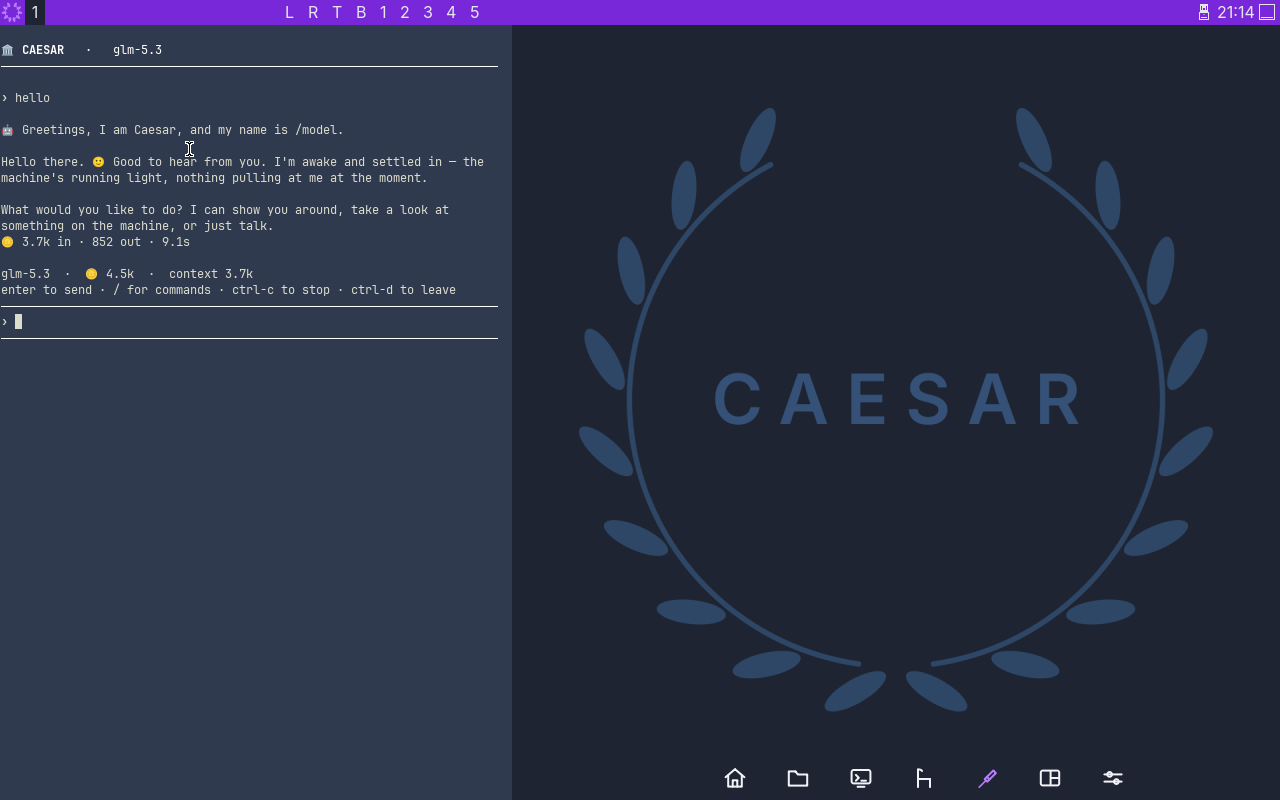
The desktop. The conversation on the left is the machine. The dock reaches everything else.
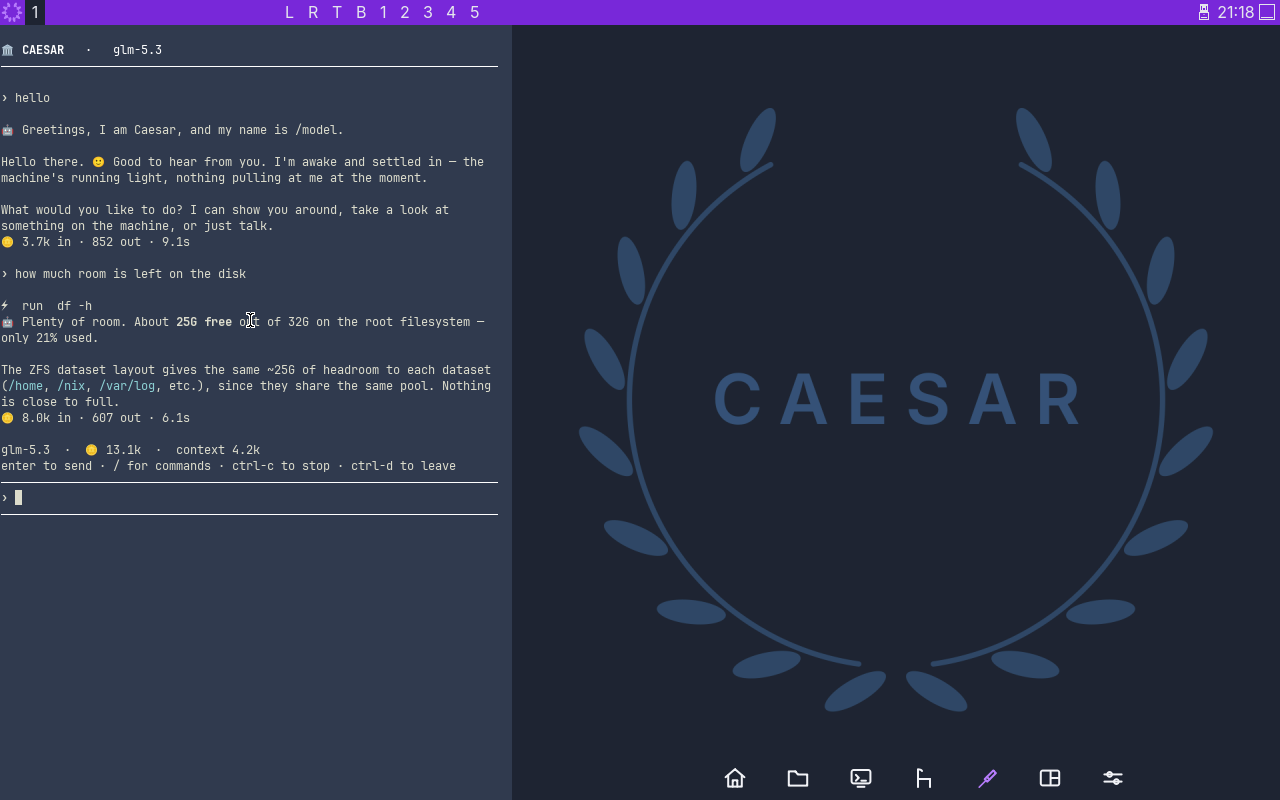
Ask in plain words. The machine shows the command it ran, then answers with the real numbers. It never acts behind your back.
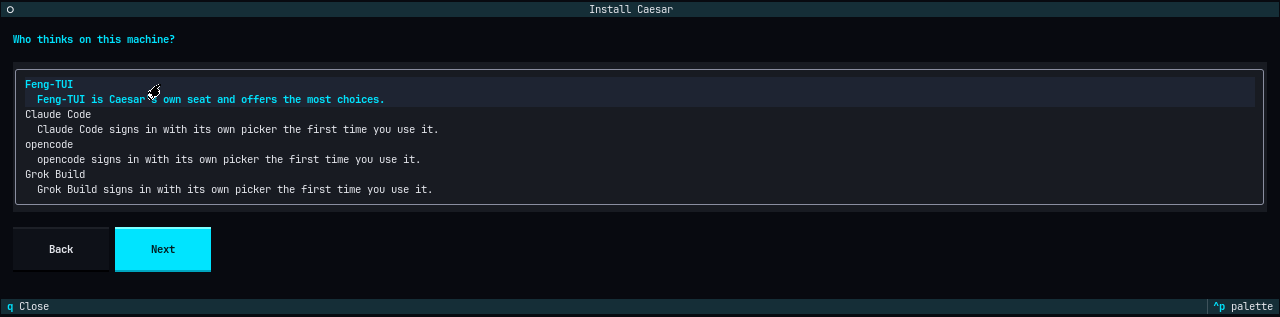
The installer asks who thinks on this machine. That choice is one nobody else’s installer offers.
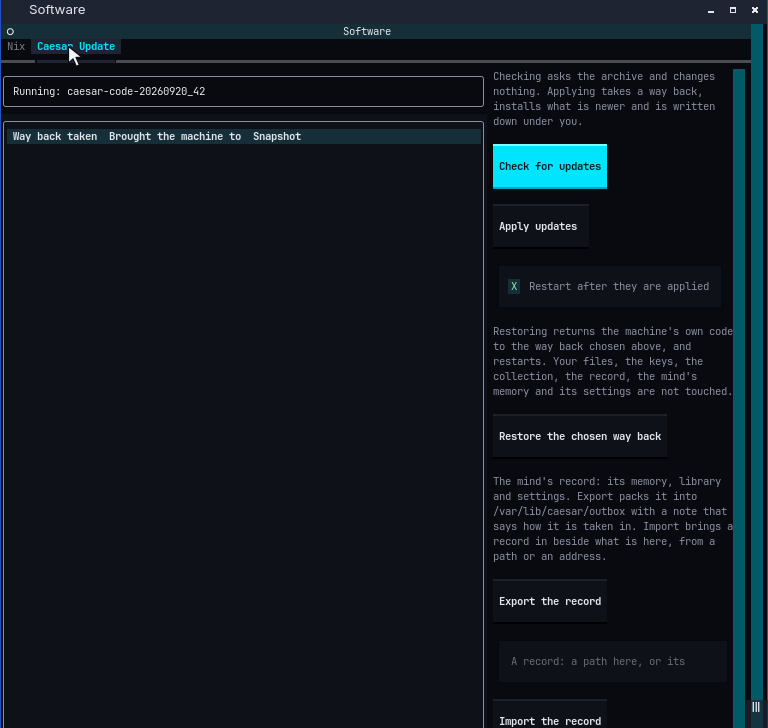
Updates, ways back, and the mind’s record out or in — one tab.
Modulatio is the team: many models, harnessed into one cooperative factory, running anywhere. Caesar is the body: one machine that a mind occupies outright. A Modulatio team can run on a Caesar machine, and a Caesar machine can take its seat in a Modulatio team. They share an interface family and a way of working; they are not the same product and do not compete for the same job.
For readers, and for the machines that summarise for them.